
Trade Area Analysis Converse’s Law Calculator|Free Calculation of the New Law of Retail Gravitation
Where should you open your store?
In retail, restaurant, and service industries, location conditions are an extremely important factor that greatly affects sales.
The "Trade Area Analysis Converse’s Law Calculator" is a free web app that uses Converse’s Law to analyze how much purchasing power is attracted from a small city to a large city.
By entering population size and the distance between cities, you can easily calculate the proportion of customers flowing from a small city to a large city.
Please use this tool for store expansion strategy, location analysis, trade area analysis, and marketing analysis.
Click here for instructions on how to use the "Converse’s Law Calculator"
What Is Converse’s Law?
Converse’s Law is a trade area analysis theory that analyzes the flow of purchasing power between a large city and nearby smaller cities.
It is also known as the "New Law of Retail Gravitation."
This theory is based on the following ideas:
- Large cities have stronger commercial attractiveness
- Large cities tend to attract new stores and large commercial facilities
- Residents of small cities are more likely to shop in large cities
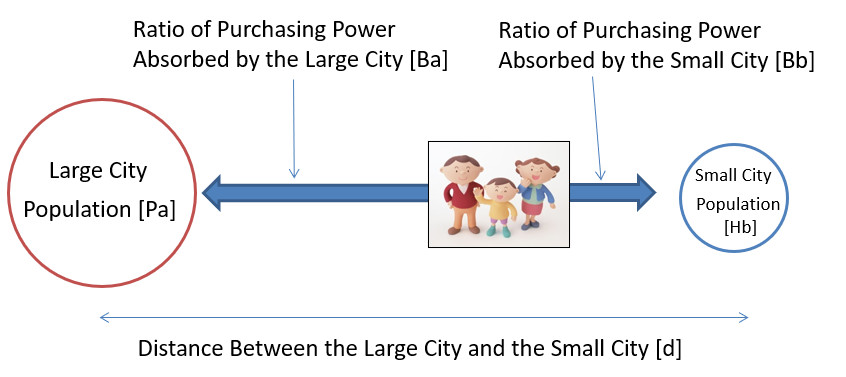
In other words, when a large city exists nearby, customers and purchasing power from smaller cities are more likely to be drawn toward the large city.
The concept is illustrated below.
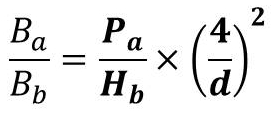
The Converse’s Law formula is shown below.
The Concept Behind Converse’s Law
Large cities attract many advantages such as:
- Large shopping malls
- Popular brand stores
- Trending new stores
- Wide product selections
Because of these attractions, residents of small cities tend to travel to nearby large cities for shopping.
Converse’s Law is a theory used to numerically analyze this "customer outflow toward large cities."
2. What You Can Learn with the Converse’s Law Calculator
This application allows you to calculate Ba, the proportion of customers from a small city who are attracted to a large city.
Is there a large city near the city where you want to open your store?
Large cities are generally more attractive than small cities, so nearby large cities may absorb purchasing power from smaller surrounding cities. Be careful about nearby urban competition when selecting a store location.
When opening a store, location conditions are especially important. Even if the service quality is somewhat poor, a good location can still generate strong sales. Conversely, even excellent products and services may fail if the location conditions are poor.
Location conditions are therefore an extremely important factor when starting a business.
This application allows you to numerically evaluate whether the city where you want to open your store is advantageous or disadvantageous compared to nearby cities.
What You Can Do with This Calculator
- Calculate Ba, the proportion of customers flowing from a small city to a large city
- Analyze purchasing power attraction by large cities
- Analyze risks for potential store locations
- Compare competitiveness with nearby cities
- Create reference materials for trade area and location analysis
- Learn marketing analysis
If there is a large city near your planned store location, you can analyze customer outflow risks in advance.
Where Converse’s Law Is Used
- Store expansion analysis in regional cities
- Market research for shopping malls
- Trade area analysis in retail businesses
- Location strategies for restaurants
- Franchise expansion planning
- Analysis of competition between cities
Why the Presence of Large Cities Matters
When considering a store location, whether a large city exists nearby is extremely important.
If a large city is nearby:
- Customers are more likely to flow toward the large city
- Purchasing activity becomes less likely to remain within the local area
- Competition becomes more intense
These risks become more significant.
On the other hand, if there is sufficient distance from a large city, purchasing activity is more likely to remain within the small city itself.
By using Converse’s Law, you can analyze these customer outflow risks in advance.
Why Location Conditions Determine Business Success
In retail businesses, location conditions have a major impact on sales.
If the location is good, attracting customers becomes easier even if there are some service issues.
Conversely, no matter how excellent your products or services are, it is difficult to attract customers if the location is poor.
Therefore, it is important to numerically analyze:
- Which city to open your store in
- Whether there is a large city nearby
- Whether customer outflow risks are high
Converse’s Law is one of the representative theories used to make these location strategy decisions based on data.
Recommended for These People
- People considering opening a new store
- Store development managers
- Retail and restaurant business owners
- Marketing professionals
- Students who want to learn trade area analysis
- People researching business strategy
Calculate Converse’s Law for Free!
Simply enter the population and distance between cities to easily analyze customer outflow risks toward large cities.
Please use this tool for store expansion strategy, location analysis, and trade area analysis.